How to Choose the Best Home Charging Station?
Choosing a Home Charging Station is less about buying the fastest unit and more about matching charging equipment to your car, home, and daily routine. The International Energy Agency’s Global EV Outlook 2024 reports that nearly 14 million electric cars were sold worldwide in 2023. That growing market makes reliable home charging an everyday consideration, not a niche upgrade. Small details matter.
Start with your vehicle’s connector and maximum AC charging rate. Then check your home’s electrical capacity, available circuit, and the distance from the parking spot to the outlet. In North America, Level 2 chargers typically use 240-volt service; installation needs should be confirmed by a qualified electrician. A long cable may reach the driveway, but it can also create a trip hazard. Check safety certifications, warranty terms, weather rating, and whether the station supports scheduled charging or load management. The right feature is the one you will actually use.
A useful comparison should include the charger price, installation quote, and any electrical upgrades—not just the advertised charging speed. The U.S. Department of Energy’s Alternative Fuels Data Center explains how charging levels differ, but real charging time still depends on the vehicle and electrical setup. No single station suits every home. Even a careful checklist has limits: older wiring, shared parking, or changing vehicles can alter the decision. A grounded choice weighs convenience against cost, safety, and future flexibility, then confirms the details before installation.
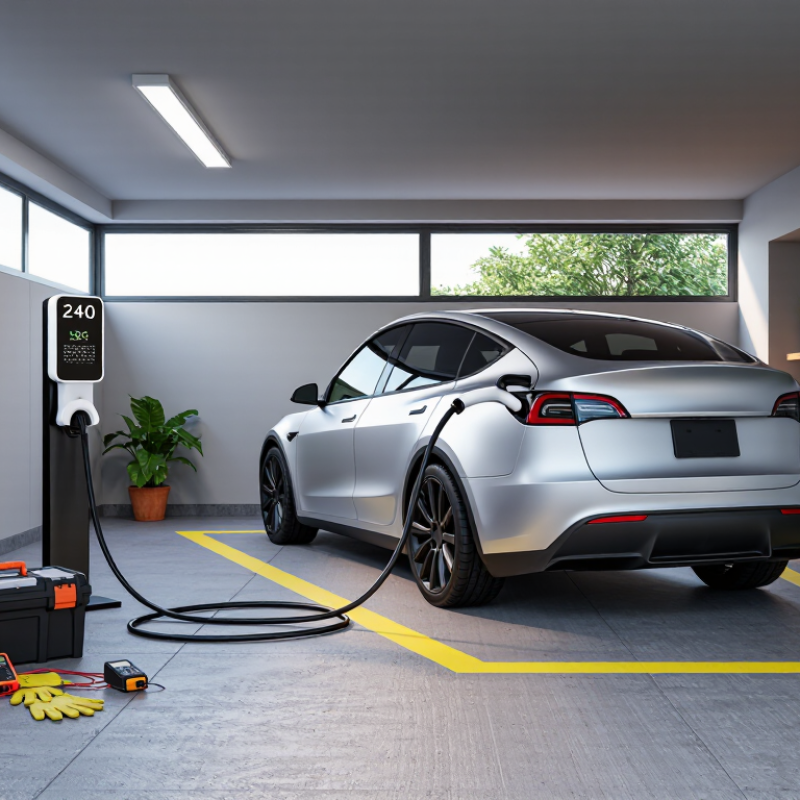
Estimate Charging Demand from Daily Miles and Battery Capacity
Estimate charging from energy used each day, not just the battery’s advertised size. The Federal Highway Administration’s 2022 National Household Travel Survey puts average daily U.S. travel at about 30 miles, though commutes and errands vary widely. Check your own odometer for a typical week. Real routines matter more.
Use the vehicle’s energy consumption, usually shown in kilowatt-hours per 100 miles, to estimate daily demand. For example, a car using 28 kWh per 100 miles needs about 10 kWh for a 35-mile day. On a 60-kWh usable battery, that is roughly one-sixth of capacity. Add a little margin for cold weather, cabin heating, and charging losses. The estimate will still be imperfect.
The U.S. Department of Energy’s Alternative Fuels Data Center says Level 2 charging typically adds about 10–20 miles of range per hour. Replacing 35 miles may therefore take roughly two to four hours, depending on the car and equipment. Small detail, big difference. A larger battery does not automatically require a higher-powered home station if daily use is modest. Compare your weekday demand with the overnight hours available, then allow extra time for unusually long trips.
Compare 120 V Level 1 with 208/240 V Level 2 Charging
Choosing a home charger starts with one practical question: how far do you drive each day? A standard 120 V Level 1 outlet is simple, but it adds only about 2–5 miles of range per hour, according to the U.S. Department of Energy’s Alternative Fuels Data Center. That can cover a short commute when the car sits plugged in overnight. It may feel painfully slow after a long weekend drive.
A standard 120 V Level 1 outlet adds about 2–5 miles of range per hour.
A 208/240 V Level 2 station typically adds about 10–20 miles per hour, the same DOE source reports.
For many drivers, that means a more reliable overnight refill. The exact rate still depends on the vehicle’s onboard charger, the station’s output, and battery conditions. A higher-rated station cannot make every car charge faster.
Installation matters. A 240 V circuit may require electrical upgrades, and the final cost depends on the home’s wiring and panel capacity. Ask a qualified electrician to assess the route from panel to parking spot; a detached garage can change the estimate.
Check your actual charging pattern for a week before choosing. One detail is easy to overlook: Level 1 may be enough for predictable, low daily mileage, while Level 2 buys flexibility. Not everyone needs that flexibility. DOE figures are typical ranges, not a promise for every vehicle or season.
Match EVSE Output to Wiring: 40 A Charging Requires a 50 A Circuit
Choosing a home charging station means matching its output to the circuit, not just selecting the highest number. A 40-amp EVSE typically needs a 50-amp branch circuit because EV charging is treated as a continuous load under common electrical rules. The extra capacity is intentional. It helps prevent the circuit from operating at its limit for hours. Still, exact requirements depend on the equipment instructions and local electrical rules.
A breaker alone does not tell the whole story. The wire must have suitable ampacity, and long cable runs, warm spaces, or other loads can affect the design. A qualified electrician can check these details before installation. Ask whether the unit is configured for 40 amps and whether the circuit supports that setting.
Some stations allow lower output, which may suit an existing circuit, though charging will take longer. Small details matter. I once focused too much on the charger’s advertised speed; the home wiring was the real constraint.
Choose a station only after confirming the circuit plan, and avoid increasing its current setting beyond what the installed wiring safely supports.
Check Connector Standards: SAE J1772 and SAE J3400 (NACS)
Before choosing a home charging station, check the inlet on your vehicle. SAE J1772 is the familiar AC connector on many North American electric vehicles. SAE J3400, the standardized form of the North American Charging System connector, is another option. The plugs look different. That small detail can determine whether a cable connects directly or needs an adapter.
For home charging, either connector can deliver AC power, but the car’s onboard charger also affects charging speed. The U.S. Department of Energy’s Alternative Fuels Data Center estimates that Level 2 charging typically adds about 10 to 20 miles of range per hour. That is a broad estimate, not a promise; vehicle limits and electrical supply matter. SAE’s J3400 standard specifies the connector, while SAE J1772 defines its own connector requirements. Check your vehicle manual and the station’s compatibility details before buying.
An adapter may bridge a J1772 station and a J3400 vehicle, or the reverse, but compatibility depends on the specific equipment. Confirm that the adapter is intended for the charging direction and power level you need. Keep the connector dry, inspect it for damage, and make sure it seats fully. It is easy to focus on advertised charging speed and overlook the cable end. I would not assume that every adapter works with every setup.
Review UL 2594 Safety Listing, Installation Costs, and Smart Features
A home charging station should be judged by its safety listing, installation needs, and everyday controls—not just its advertised charging speed. UL 2594 covers electric vehicle supply equipment, including electrical safety requirements. Check that the exact charger model is listed by a recognized testing organization; a safety logo on a sales page is not enough. The U.S. Department of Energy’s Alternative Fuels Data Center says Level 2 charging typically adds about 10–20 miles of range per hour. That makes circuit capacity and correct installation important.
Installation costs depend on the distance from the electrical panel, wiring route, and whether the panel needs an upgrade. Angi’s 2024 cost guide estimates home charger installation at roughly $800–$2,500, though complex electrical work can raise the bill. Request an itemized quote covering equipment, labor, permits, and any panel work. A low quote may leave out a crucial detail.
Smart features can add practical value: scheduled charging may help shift use to lower-rate hours, while load management can limit demand on a home circuit. Confirm these controls work with your utility plan and home electrical setup.
Tips: Ask the electrician to verify panel capacity and inspect the intended mounting spot before you buy. Compare the charger’s listed safety certification, cable reach, and warranty. If you rarely check an app, skip features you will not use. A simple setup can be the better choice.