
Blog
7 Tips for Choosing a Pallet Transfer Conveyor
Choosing a Pallet Transfer Conveyor is not simply a matter of matching pallet size with belt width. It affects product flow, worker safety, maintenance time, and future expansion. A reliable choice begins with the real operating environment: pallet weight, load dimensions, transfer direction, cycle frequency, and available floor space. Measure the awkward details, too. A slightly uneven floor can change alignment, noise, and roller wear.
Taiichi Ohno, the manufacturing engineer behind the Toyota Production System, said, “Without standards, there can be no improvement.” That principle remains useful when evaluating a Pallet Transfer Conveyor. Compare rated capacity, transfer speed, motor location, guarding, controls, and access for cleaning. Check whether the conveyor can handle damaged pallets, not only perfect ones. It sounds minor. It is not.
The best system may include chain transfer units, powered rollers, lift platforms, or a combination of technologies. Each option creates different maintenance demands. A high-speed design can look impressive, yet it may be unnecessary for a slow warehouse lane. A cheaper frame might also produce expensive vibration later. I have seen specifications focus heavily on throughput while ignoring pallet entry conditions and operator reach. That is an easy mistake.
Consider accumulation space, emergency stops, sensor placement, noise levels, and spare-part availability. Ask the supplier for load-test data and installation references from similar facilities. Review the control logic with the people who will maintain it. Their concerns may expose gaps in the original plan. There is no perfect conveyor. However, a careful selection process can make material movement safer, steadier, and easier to improve.
Define the Conveyor’s Role in Your Pallet Handling Process
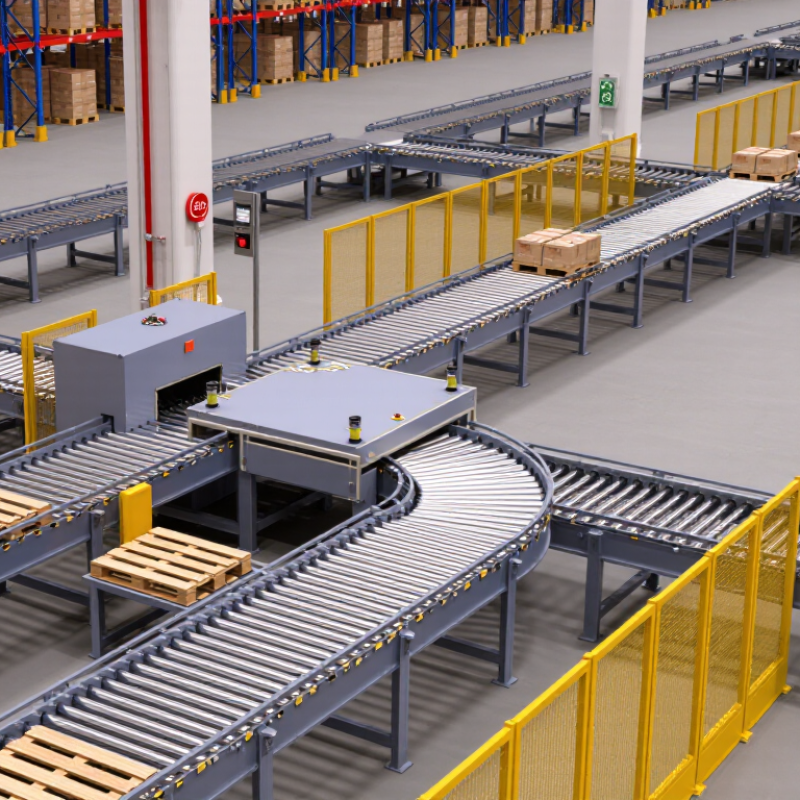
Before selecting a pallet transfer conveyor, define its exact role in the handling process. Is it receiving loaded pallets, changing direction, buffering orders, or feeding a packing station? Each function creates different demands for speed, spacing, and control. A transfer point should solve a specific movement problem, not simply fill unused floor space.
In working facilities, I have seen conveyors perform well until operators introduce uneven loads or damaged pallets. Then small gaps become serious delays. Observe the process during peak hours. Measure pallet dimensions, load weights, transfer frequency, and available clearance. Record where operators wait, turn, or manually push pallets. These details reveal whether you need a chain transfer, roller transfer, turntable, or another design.
The conveyor must also match the surrounding equipment. Check the infeed height, discharge height, pallet orientation, and stopping accuracy. Consider dust, moisture, temperature, and cleaning routines. Safety controls should provide visible stops and controlled restart procedures. Do not rely only on catalog capacity. A conveyor rated for heavy pallets may still struggle with poor load distribution or unstable stacking.
Leave room for maintenance access. It matters. A narrow service area can turn a simple sensor replacement into hours of downtime. I once underestimated operator reach near a transfer zone; the layout worked mechanically but felt awkward during repeated shifts. That mistake changed the design review. A practical trial with real pallets often exposes weaknesses that drawings cannot.
Match Conveyor Capacity and Dimensions to Your Pallet Requirements
Tip 1: Measure the pallet, not only its label. Record length, width, height, weight, and load overhang. A 1,200-by-1,000-millimeter pallet may need extra side clearance. Tip 2: Match conveyor width to the pallet’s weakest support points. Undersizing creates instability. Tip 3: Check the heaviest real load, including unevenly placed cartons. Capacity must exceed that working load, not just the average.
Tip 4: Calculate the required transfer rate. Count pallets per hour, transfer distance, and expected peak periods. A conveyor rated for 20 pallets per hour may struggle when production suddenly reaches 30. Leave practical capacity margin. It matters. Tip 5: Confirm roller spacing and pallet bottom-board design. Narrow boards, damaged runners, or gaps can cause jolting. I have seen a suitable conveyor fail because the pallet base was treated as an afterthought.
Tip 6: Review transfer height carefully. Small height errors can catch pallet runners, especially during side transfers. Check forklift approach, surrounding equipment, and floor levels before approval. Tip 7: Test unusual pallets, not only the clean sample. Moisture, tilted loads, and loose cartons reveal weaknesses. A perfect calculation cannot replace a physical trial. My own specifications have occasionally been too optimistic; revisiting them early is cheaper than modifying an installed line. Reliable selection comes from measured dimensions, verified load data, and honest operating assumptions.
| Tip | Selection Dimension | Typical Pallet Requirement | Recommended Conveyor Specification | Why It Matters |
|---|---|---|---|---|
| 1 | Confirm pallet dimensions | Common footprints include 1,200 × 800 mm, 1,200 × 1,000 mm, and 1,219 × 1,016 mm. | Select a conveyor width that supports the pallet load surface. For chain or roller conveyors, allow approximately 50–100 mm of lateral clearance in total, subject to the equipment design. | Correct sizing prevents pallet overhang, contact with guarding, and unstable transfers. |
| 2 | Calculate maximum load capacity | Determine the heaviest combined load, including the pallet, product, packaging, and any unevenly distributed weight. Example design load: 1,500 kg. | Choose a rated capacity above the maximum operating load. A practical engineering allowance is often 15–25%, subject to the conveyor supplier’s calculations and local safety requirements. | A reserve capacity helps accommodate load variation, impact during loading, and long-term component wear. |
| 3 | Match the conveyor type to the pallet base | Pallet bases may use perimeter boards, full lower decks, runners, feet, or uneven bottom surfaces. | Use powered rollers when the bottom is reasonably flat and continuous. Use a chain conveyor or a multi-strand design when the pallet has defined runners or load-bearing rails. Confirm the minimum contact area with the pallet manufacturer. | The wrong contact pattern can cause vibration, skewing, incomplete transfers, or excessive wear on the pallet. |
| 4 | Set the transfer speed and spacing | Typical pallet handling speeds range from 0.10–0.50 m/s, depending on the process, product stability, and automation sequence. | Specify the required throughput in pallets per hour. For example, a line handling 60 pallets/hour needs an average cycle time of about 60 seconds per pallet, excluding accumulation and control delays. | Speed, pallet length, transfer distance, and gap determine whether the conveyor can meet the required throughput. |
| 5 | Allow adequate conveyor length and transfer overlap | The pallet must be fully supported during start, stop, direction change, and handoff between conveyor sections. | Size the active conveyor zone so that the pallet has stable support at both ends. At transfers, maintain sufficient overlap between adjacent rollers, chains, or lifting mechanisms to prevent unsupported pallet edges. | Proper support reduces tipping risk and helps maintain pallet alignment at junctions and transfer stations. |
| 6 | Check height, floor conditions, and installation clearances | Common working heights are approximately 450–900 mm, but the correct height depends on loading, picking, and connection points. | Verify floor levelness, anchoring locations, aisle width, overhead obstructions, access for forklifts or pallet trucks, and maintenance clearance. Include space for guarding and emergency access. | A conveyor that fits the pallet but not the building can create unsafe access, difficult maintenance, and costly rework. |
| 7 | Plan for environment and future capacity | Consider temperature, moisture, dust, washdown exposure, corrosion, pallet condition, and expected changes in load or throughput. | Select suitable frame and component protection for the environment. If expansion is expected, reserve control capacity, floor space, and electrical provisions for approximately 10–20% additional throughput where practical. | Environmental compatibility improves service life, while planned capacity helps avoid premature system replacement. |
Evaluate Transfer Methods, Speed, and Operational Flexibility
7 Tips for Choosing a Pallet Transfer Conveyor
Evaluate Transfer Methods, Speed, and Operational Flexibility
Tip 1: Match the transfer method to the pallet load. Chain transfers suit heavy, stable pallets, while roller transfers support smoother movement. Check pallet condition, underside gaps, and load balance before deciding. A small gap can cause a major stoppage.
Tip 2: Measure real operating speed, not only the advertised rate. Record pallet spacing, acceleration, stopping distance, and transfer time. Tip 3: Compare continuous movement with indexing. Continuous flow may increase output, but indexing can improve positioning accuracy. Faster is not always better.
Tip 4: Examine how the conveyor handles different pallet sizes. Adjustable guides, sensors, and modular sections can reduce changeover time. Tip 5: Check transfer accuracy near scanners, wrappers, or robotic stations. Even a few centimeters of drift may interrupt downstream work. During site assessments, I have seen clean layouts fail because sensors were positioned too close to transfer points.
Tip 6: Test flexibility during abnormal conditions. Ask how operators clear a stalled pallet, reverse movement, or isolate one section. Emergency access should be practical, not theoretical. Tip 7: Review maintenance access, spare components, and control integration. A technically impressive system may still create delays if routine inspections require excessive disassembly. Leave room for improvement. Real facilities change, and the best conveyor should adapt without forcing a complete redesign.
Check Safety Features, Maintenance Needs, and System Durability
7 Tips for Choosing a Pallet Transfer Conveyor
Safety should be checked before speed or price. The U.S. Bureau of Labor Statistics reported 2.6 million nonfatal workplace injuries in private industry during 2023. OSHA’s 2023 enforcement data also recorded 2,701 machine-guarding violations and 2,554 lockout/tagout violations. These figures make guarding, isolation, and access control practical priorities. Choose fixed guards around chains and pinch points. Add clearly visible emergency stops and pull cords. Photoelectric sensors should stop movement when a pallet leaves its expected zone. Test them with real loads, not only empty pallets.
Maintenance needs equal attention. Ask whether technicians can reach bearings, drives, sensors, and tensioning points without removing half the conveyor. Check lubrication intervals, washdown requirements, spare-part availability, and fault diagnostics. A simple inspection checklist can prevent a small misalignment from becoming a damaged pallet. Follow ANSI/ASME B20.1 guidance and your site’s risk assessment. Do not assume a supplier’s standard layout fits every process. It often does not.
Durability depends on duty cycle, pallet weight, impact, corrosion, and temperature. Request documented load ratings, testing methods, and expected service intervals. Compare the frame thickness, roller design, weld quality, and motor protection. A conveyor rated for average loads may fail under repeated shock loading. A perfect specification is unrealistic. Recheck it after observing actual shifts, including rushed loading and uneven pallets. That uncomfortable review may reveal more than a polished brochure.
Compare Integration Options, Costs, and Supplier Support
Choosing a pallet transfer conveyor should begin with integration, not catalog price. Map pallet dimensions, loads, sensors, safety zones, and existing controls. A chain transfer suits fixed pallet paths, while a roller transfer may handle smoother, quieter movement. Confirm cycle time under peak demand, not during an easy test. Ask for interface drawings and a site acceptance plan. Small gaps become expensive later.
Compare total cost over five years. Include conveyor hardware, controls, structural work, installation, training, spare parts, energy, and planned downtime. MHI’s 2024 Annual Industry Report found that 55% of supply chain leaders planned to increase technology investment. That signals confidence, but not permission to overspend. Request at least three itemized quotations. Check what each excludes. Cheap integration can hide costly electrical changes.
Supplier support deserves equal weight. Require response-time targets, remote diagnostics, maintenance training, and local replacement-part availability. Ask for references using similar pallet weights and temperatures. The report also stated that 83% of leaders viewed supply chain technology as a competitive advantage. That benefit depends on dependable support. I would score suppliers on documentation and troubleshooting, not polished demonstrations. My own practical caution is simple: projected savings often look precise, while congestion and changeovers remain uncertain. Build a contingency allowance, test a difficult pallet, and revisit the design with operators before approval.
