Blog
What Are the 2026 Top Refrigeration Condensing Unit Types?
Choosing the right Refrigeration Condensing Unit in 2026 will require more than comparing horsepower or purchase price. Field experience shows that operating conditions often decide performance. A unit beside a dusty supermarket loading bay faces different demands from one serving a clean, temperature-controlled warehouse. Noise, ambient temperature, service access, refrigerant availability, and electrical supply all matter.
The leading choices will likely include air-cooled, water-cooled, evaporative, low-temperature, and transcritical CO2 condensing units. Air-cooled models remain practical for many commercial sites because installation is simpler. Water-cooled units can perform steadily where water systems are available. Evaporative designs may improve efficiency in hot climates, but water treatment adds responsibility. CO2 systems offer strong environmental advantages, although high operating pressures require skilled design and maintenance. The “top” type is not universal. That answer is less tidy.
As refrigeration engineer Stephen Yurek has stated, “Efficiency must remain central as HVACR technology evolves.” This principle deserves careful interpretation. Efficiency is not only a laboratory rating. It includes stable box temperatures, reduced cycling, accessible components, and dependable performance during a summer heatwave. In this guide, we will compare the major 2026 condensing unit types through capacity, refrigerant compatibility, controls, energy use, and service demands. Manufacturer data and local installation requirements should guide the final decision. Even experienced contractors can miss one detail. A poorly matched condenser can erase the benefits of advanced technology.
Definition and Core Function of Refrigeration Condensing Units
A refrigeration condensing unit is the system’s heat-rejection engine. It normally contains a compressor, condenser, receiver, fan, and control devices. The compressor raises refrigerant pressure and temperature. The condenser then releases heat into air or water. Refrigerant becomes liquid again. This cycle prepares it for the expansion device and evaporator.
The International Institute of Refrigeration estimates that refrigeration uses about 17% of global electricity. That figure explains why condensing-unit selection matters. Air-cooled units remain practical for supermarkets, cold rooms, and small factories.
Water-cooled units can perform steadily in hot environments, but they need clean water and careful maintenance. Scroll and semi-hermetic compressor designs serve different load patterns. Carbon-dioxide systems also attract attention where lower environmental impact is required.
The FAO’s State of Food and Agriculture 2023 report states that 13.2% of food was lost between harvest and retail in 2021. Reliable refrigeration can reduce part of this loss, although equipment alone cannot solve weak logistics. In daily operation, technicians inspect oil levels, coil cleanliness, suction pressure, and abnormal vibration.
A dirty condenser may look harmless. It can quietly increase energy use and discharge temperature.
The UNEP Food Waste Index Report 2024 estimated 1.05 billion tonnes of food waste in 2022. Better system design helps, but temperature control still depends on people, sensors, and timely servicing.
How Condensing Units Work in Modern Refrigeration Systems
What Are the 2026 Top Refrigeration Condensing Unit Types?
Modern refrigeration depends on a simple heat-transfer sequence. The compressor draws in low-pressure vapor and raises its pressure. The condenser then rejects heat to air or water. Refrigerant leaves as a high-pressure liquid, ready for expansion and evaporator cooling. A condensing unit is not the entire system. It is the heat-rejecting engine behind it.
Air-cooled units remain practical for supermarkets, cold rooms, and small warehouses. They need less water infrastructure and simpler maintenance. Water-cooled units can perform efficiently in steady, high-load applications, but pumps, treatment, and local water rules add complexity. Scroll and semi-hermetic compressors suit different load patterns. Variable-speed models can reduce cycling losses when demand changes during the day.
The International Energy Agency reports that cooling energy demand has tripled since 1990 and may triple again by 2050. This pressure is shaping 2026 equipment choices. The Kigali Amendment targets an 80% or greater global reduction in hydrofluorocarbon use by 2045, according to UNEP. Low-global-warming-potential refrigerants therefore matter more in equipment selection. Natural refrigerants can support this shift, but safety training and proper system design remain essential. Field reality is messier. A high-efficiency unit can waste energy when coils are dirty, airflow is blocked, or controls are poorly commissioned. Engineers should compare seasonal performance, sound levels, service access, refrigerant charge, and operating conditions—not only the catalog rating.
The Main Types of Refrigeration Condensing Units in 2026
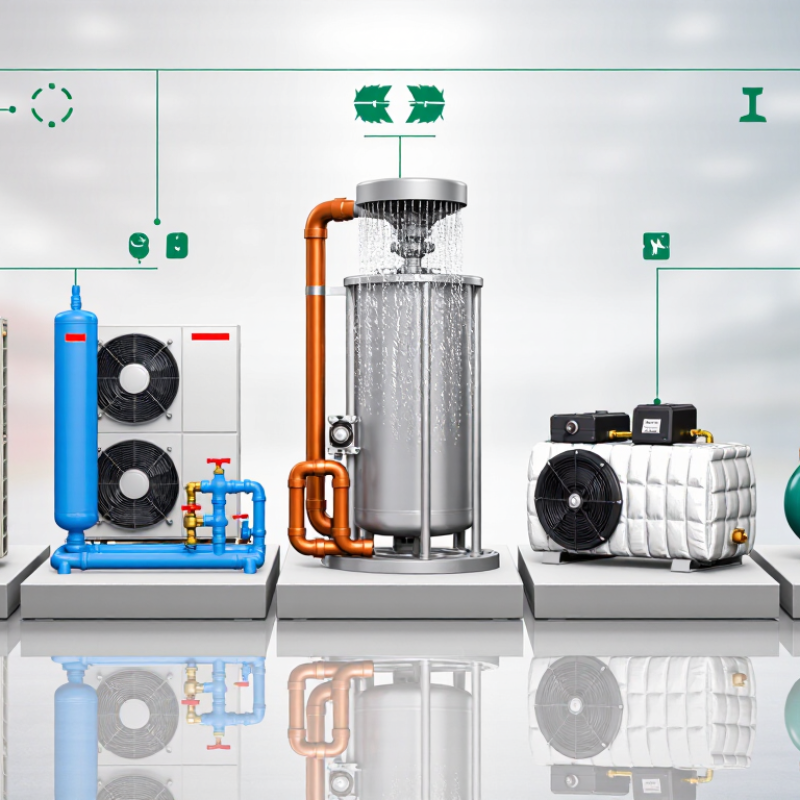
The main refrigeration condensing unit types in 2026 are air-cooled, water-cooled, and evaporative models. Each design removes heat differently, so the installation environment matters greatly. Air-cooled units use outdoor fans and condenser coils. They are simpler to install and maintain, especially where water is limited. However, high summer temperatures can reduce efficiency and increase discharge pressure.
Water-cooled units transfer heat through a water circuit and cooling tower or dry cooler. They suit large cold-storage facilities with stable water management systems. Their performance is often more consistent, but pumps, water treatment, and scale control add maintenance work. Evaporative condensing units combine air movement with controlled water evaporation. They can achieve lower condensing temperatures, which may reduce compressor energy use. Still, water quality and hygiene require careful monitoring.
Another important classification concerns compressor construction. Semi-hermetic units allow service access and are common in commercial refrigeration. Hermetic units are compact and sealed, making them useful for smaller systems. Variable-speed compressors are becoming more practical in 2026 because they match capacity with changing loads. That can reduce cycling and temperature swings. It is not always better.
A reliable selection process considers refrigerant compatibility, ambient temperature, noise limits, electrical supply, and service access. Technicians should check airflow clearances and actual load conditions, not rely only on catalog ratings. Small design mistakes can create large energy losses. Details matter. There is no universal winner.
Key Differences in Performance, Efficiency, and Applications
Air-cooled condensing units remain a practical choice for supermarkets, restaurants, and small cold rooms in 2026. Their fans reject heat directly into the surrounding air, so installation is relatively simple. They need less water and usually demand less maintenance than water-cooled systems. However, efficiency can fall during a hot afternoon, especially when condenser coils collect dust. That detail is easy to underestimate.
Water-cooled units often deliver steadier performance in warm climates. A cooling tower or closed-loop circuit removes heat more effectively than ambient air. This can reduce condensing pressure and improve compressor efficiency during heavy loading. The trade-off is clear: pumps, water treatment, and leak inspections add operating work. They suit large facilities with reliable mechanical rooms and skilled maintenance teams.
Evaporative condensing units can achieve strong efficiency where dry air is available. They combine airflow with controlled water evaporation, lowering the refrigerant condensing temperature. Energy use may decrease, but water consumption and mineral buildup require attention. Natural refrigerant systems, including carbon dioxide units, are gaining interest for demanding retail applications. They can reduce environmental impact, yet high-pressure components require careful design and trained technicians. Performance depends on climate, load profile, refrigerant choice, and service quality. I have seen projects choose the most efficient catalog option, then struggle with poor airflow and limited access. The “best” unit is sometimes only the best fit on paper.
How to Select the Right Condensing Unit for Each Refrigeration Need
Choosing a refrigeration condensing unit starts with the operating environment, not the catalogue photo. In 2026, common options include air-cooled, water-cooled, scroll, semi-hermetic, and variable-speed units. Air-cooled models suit many retail rooms and workshops. They need clear airflow around the condenser. Water-cooled units can perform steadily in hot spaces, but they require reliable water management. Noise matters near restaurants, hotels, and residential areas.
Match the unit to the temperature range and load pattern. A freezer holding -25°C needs different compressor protection than a chilled display at 2°C. Check the evaporating temperature, ambient temperature, refrigerant compatibility, and peak product load. A small cold room may cycle lightly during the night, then work hard after morning deliveries. Variable-speed capacity can reduce cycling in that situation. It is not always the cheapest choice.
Field experience also shows that installation details change performance. A unit placed beside a dusty loading dock may lose efficiency quickly. Leave service space for coil cleaning, electrical checks, and fan replacement. Review defrost schedules and starting current before approval. I have seen otherwise correct selections struggle because the condenser was undersized for summer heat. That mistake is easy to repeat. Ask for tested capacity data, sound levels, control requirements, and maintenance access before ordering.
| Condensing Unit Type | Typical Compressor Configuration | Common Refrigeration Applications | Typical Evaporating Temperature* | Indicative Cooling Capacity Range* | Suitable Refrigerant Options** | Main Advantages | Key Selection Considerations |
|---|---|---|---|---|---|---|---|
| Hermetic Reciprocating Condensing Unit | Single sealed reciprocating compressor | Small display cases, reach-in coolers, small cold rooms, beverage coolers and light commercial refrigeration | Approximately −40°C to +5°C | Approximately 0.3–15 kW | R290, R600a, R134a, R513A and other approved refrigerants, depending on design | Compact construction, relatively low initial cost, simple installation and broad availability | Limited serviceability because the compressor shell is sealed; check starting current, acoustic performance, charge limits and local flammability requirements |
| Semi-Hermetic Reciprocating Condensing Unit | Serviceable reciprocating compressor with bolted housing | Medium-sized cold rooms, supermarkets, food processing rooms, refrigerated warehouses and process cooling | Approximately −45°C to +10°C | Approximately 2–100 kW | R448A, R449A, R404A in legacy systems, R134a, R513A, R290 and other approved refrigerants | Repairable compressor, strong low-temperature capability, flexible capacity selection and good field serviceability | Usually larger and noisier than hermetic units; verify oil type, discharge temperature, liquid management and compatibility with the selected refrigerant |
| Scroll Condensing Unit | Fixed-speed or digitally modulated scroll compressor | Medium-temperature cold rooms, retail cases, convenience stores, small supermarkets and comfort/process cooling | Approximately −30°C to +10°C | Approximately 1–60 kW | R410A, R32, R134a, R513A, R448A, R449A, R454C and other approved refrigerants | High efficiency, low vibration, compact footprint, fewer moving parts and reliable operation under stable load conditions | Not every scroll model is suitable for low-temperature operation; check liquid-return protection, operating envelope, oil return and modulation range |
| Variable-Speed Scroll Condensing Unit | Inverter-driven scroll compressor with electronic speed control | Retail refrigeration with fluctuating demand, temperature-sensitive storage, small cold-chain facilities and applications requiring tight temperature control | Approximately −30°C to +10°C | Approximately 1–30 kW per compressor | R290, R32, R410A, R454C, R513A and other approved refrigerants | Good part-load efficiency, reduced cycling, lower starting current and improved temperature stability | Requires compatible drive electronics, electromagnetic compatibility planning, proper oil return and protection against operation outside the approved speed range |
| Two-Stage or Compound Reciprocating Unit | Two compression stages or compound compression arrangement | Frozen-food storage, blast freezers, ice machines and other low-temperature applications | Approximately −55°C to −25°C | Approximately 3–80 kW | R404A and R507A in legacy installations; R449A, R448A, R452A and other approved low-temperature alternatives | Improved efficiency and discharge-temperature control at very low evaporating temperatures compared with many single-stage arrangements | Higher system complexity and cost; requires correct interstage control, oil management, suction superheat control and low-temperature commissioning |
| Screw Condensing Unit | Single or twin-screw compressor, often with capacity slide control or variable-speed drive | Large cold stores, food processing, industrial refrigeration, central plant rooms and continuous-duty applications | Approximately −45°C to +10°C | Approximately 30–500 kW per compressor | R717, R744, R134a, R513A, R1234ze(E) and other approved refrigerants | High capacity, durable continuous operation, good capacity modulation and suitability for industrial heat loads | Higher capital cost and installation requirements; assess oil separation, service expertise, part-load efficiency, noise and machinery-room safety |
| Parallel Compressor Condensing Unit | Multiple compressors connected to a common suction and discharge circuit | Supermarkets, distribution centers, multi-temperature cold rooms and facilities with several refrigeration loads | Approximately −45°C to +10°C, depending on the circuit | Approximately 20–500 kW total system capacity | R744, R448A, R449A, R513A, R290 and other approved refrigerants | Excellent capacity staging, redundancy, service flexibility and efficient operation across changing loads | Needs coordinated controls, oil-level management, suction-group design, receiver sizing and careful commissioning; separate medium- and low-temperature circuits may be required |
| Air-Cooled Condensing Unit | Any compatible compressor with finned condenser and fan assembly | Most commercial outdoor installations where water is limited or water treatment is undesirable | Depends on compressor and refrigerant; commonly −45°C to +10°C | Approximately 0.3–500 kW | Refrigerant selection depends on the compressor and system design, including R290, R744, R513A, R448A and R449A | Simple water-free operation, easier installation and generally lower maintenance requirements than water systems | Performance decreases as outdoor temperature rises; provide adequate airflow, coil cleaning, fan control, freeze protection and clearance from obstructions |
| Water-Cooled Condensing Unit | Compressor and condenser connected to a water circuit or cooling tower | Indoor plant rooms, high-rise buildings, dense urban sites and installations with stable cooling-water availability | Depends on compressor and refrigerant; commonly −45°C to +10°C | Approximately 5–500 kW | R134a, R513A, R744, R717 and other approved refrigerants | Stable condensing temperature, compact heat-rejection equipment and potentially strong performance in hot ambient conditions | Requires water treatment, pumps, flow protection, heat-exchanger maintenance and evaluation of water availability, operating cost and Legionella-control procedures where applicable |
| CO₂ Transcritical Condensing Unit | Typically multiple reciprocating compressors operating with a gas cooler | Supermarkets, food distribution centers, cold storage and facilities seeking a very low-GWP refrigerant | Approximately −45°C to +10°C, with system architecture dependent on the application | Approximately 20–500 kW total system capacity | R744 only | Very low global warming potential, no phase-out concern associated with HFC refrigerants and useful heat-recovery potential | High operating pressure, greater control complexity and climate-dependent efficiency; require qualified design, pressure-rated components and appropriate safety procedures |
| Hydrocarbon Condensing Unit | Usually hermetic or semi-hermetic compressor designed for flammable refrigerants | Small commercial refrigerators, compact freezers, stand-alone display equipment and selected cold-room applications | Approximately −40°C to +10°C | Approximately 0.1–25 kW, subject to charge and safety limitations | R290 propane or R600a isobutane | Very low GWP, strong thermodynamic performance and reduced refrigerant charge in compact systems | Flammability controls are essential; verify charge limits, electrical component certification, ventilation, service procedures and local building and refrigeration codes |